
In this extract from Chapter 2 of The Cosmic Egg Timer, Joyce Hopewell and Richard Llewellyn outline the historical and psychological context within which astrological psychology was developed.
“Astrology must be reborn and must perform again for our modern world, made chaotic by an unbridled and false individualism and by the sudden opening of psychological dams, the task of practical integration that has always been its own.”
Dane Rudhyar, The Astrology of the Personality 1936
Historical Context
Occasionally on a clear night, even in the modern world, you might happen on a dark place, miles from any bright lights. Standing there, are you not awe-struck by the wonder of the heavens? Surely there is meaning, as well as beauty, here.
In these days of electric lighting it is easy to forget just how important the stars and planets were for our ancestors. The heavens were naturally the subject of observation and speculation, and correlations were often noticed between events on earth and configurations of the heavens.
It seems likely that the Sumerians established the basis of modern astrology around 6000BC. Since then astrological ideas have gone through periods of popularity, and through periods of neglect and denial.
A notable flowering came in the ancient Greek era; in 560 BC. Asklepius established at Kos the first of many temples based on three prime disciplines – astrology, mythology and interpretation of dreams. Astrology was then a prime tool for understanding the human psyche.
In the second century AD Ptolemy established a synthesis of Hellenistic astrology/ astronomy that has been influential to this day.
After the so-called Dark Ages, the 15th century European Renaissance was fired by the rediscovery of Greek ideas, leading to the religious Reformation and the rise of modern science. Astrologers such as Johannes Kepler and Marcilio Ficino were prime movers in this process, as was the alchemist Isaac Newton.
This rise of science has led to the technological wonders of the modern world. However, with the coming of the so-called Enlightenment, the new scientific emphasis on objectivity, reductionism and materialism soon began to dominate public discourse in the West, generally disparaging astrology and even spirituality.
The last century has seen the culmination of a number of trends which apparently threaten the future of humanity itself – massively rising world population, an aggressive capitalism founded on the oil-based economy, leading to environmental degradation and massive species loss, destruction of indigenous communities and their way of
life, not to mention ever-more-destructive and inhumane methods of warfare.
Humanity is in crisis. Our civilisation, as many in history, is threatened with various disasters largely of its own making. What can be done to address such a crisis, and how can astrology, often denigrated through the ages by both religion and science, help?
Psychology and Spirituality
Just as the 20th century began to see the worst fruits of materialism, it also saw the green shoots of a new and sustainable way of looking at things. With the creation of the science of psychology in the early 1900s, notably through the work of Sigmund Freud, we began to understand what makes human beings tick.
Carl Jung’s psychology moved on and embraced symbolism and dreams, adding the concept of synchronicity – meaningful coincidence. The psychological knowledge of the Greeks was being reclaimed and carried forward.
Increased exposure to Eastern religions was also leading to new ideas of spirituality gaining ground in the West, driven by major figures such as H. P. Blavatsky and
Alice Bailey.
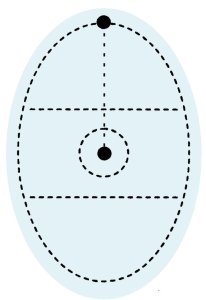
Roberto Assagioli began to bring these threads together by establishing the psychology of psychosynthesis, which takes into account the transpersonal or spiritual dimensions of experience. Assagioli developed a model of the personality – the Egg – that encapsulates its conscious and unconscious aspects and its link with the divine.
In the middle of the Egg is the conscious personal self, surrounded by its field of conscious self awareness (the circle). Other parts of the Egg’s interior represent various aspects of the unconscious. At the top is the Higher Self, the link with the divine/ spiritual nature.
Assagioli saw how the individual generally acts inconsistently, being at different times one of a number of independent subpersonalities that have evolved to cope with life’s different circumstances. What is needed is a process of synthesis and development of the will, to bring coherence to this scattered personality. With such synthesis we can effectively approach our spiritual essence.
The resurgence of spirituality continues to gain ground in the West. The dominant consumerist materialism inevitably does not in the end prove satisfying. Many people want more in their lives, but do not necessarily see value in the dec lining religions and their churches, notably because of some of their disreputable history (e.g. the Inquisition).
There is a consensus of great minds, well documented by Huston Smith, that there is in fact a common golden thread at the heart of all the world’s religions, providing a spiritual goal for each individual. To find their path to that goal, some people find the framework of organised religion helpful; to others it is at best unnecessary, or even
superficial and hypocritical.
It is clear from even a superficial understanding of spiritual values, such as the golden rule of ‘do as you would be done by’, that a more spiritual humanity will be a kinder humanity, with each person more in tune with themselves, with their fellows, and with the natural world. It does not seem unreasonable to suggest that only by becoming more spiritual will humanity gain the wisdom to solve the problems of the deteriorating global environment, caused as it is by individual human decisions and their life styles.
Changing Paradigm
As well as increased questioning of materialism, a new paradigm of science is emerging, driven by the evolution of science itself, notably the insights of Quantum Theory and Relativity. The difference in viewpoint is profound, and can be expected to increasingly pervade the general discourse of ideas. We will only consider two aspects of this change – objectivity and reductionism.
Quantum phenomena cannot be observed entirely objectively. The result of an experiment depends on what you were looking for. Is matter composed of elementary particles or of waves of energy? Look for waves and you find waves; look for particles and that is what you find.
So science is having to recognise the subjective and the inevitable role it plays in experiment. The consciousness of the scientist cannot be neglected, and there is an increase in the attempts of scientists and philosophers to understand the nature of consciousness itself, which of course cannot be explained in materialistic terms.
Quantum phenomena also show that physically disconnected objects are mysteriously linked together. The universe is more interconnected and wholistic than is allowed for in the reductionist model of inanimate, independent parts.
There is a corresponding increasing scientific interest in interconnected systems and organic wholes. Many environmental problems come about because people tinker with parts of a system without understanding the whole system – for example, a tiny marine organism Emiliana Huxleyi is a key to global rainfall. And an organic whole is more than its parts – a hive of bees is more effective than the sum of its individuals.
In the 1930s Dane Rudhyar gave us the complementary insight that, just as mathematics is the symbolic language for understanding objective science, so astrology is the symbolic language for understanding organic wholes. Each whole is born, lives a life cycle and dies – and the astrological configuration of the universe at birth gives us information shaping that life cycle. Rudhyar used this insight in promoting a psychological approach to astrology.
The Hubers and Astrological Psychology
Bruno and Louise Huber refined this marriage of astrology with psychology into a practical and effective methodology.
In the early 1950s this young Swiss couple were called to Geneva to help form a branch of the Arcane School – a spiritual school providing courses of study and meditation based around the works of Alice Bailey. This early spiritual grounding provided the rock of dedication to the well-being of others that underpinned all their subsequent work.
Bruno and Louise were then inspired to work with Assagioli in Florence for three years, helping with his development of the new psychosynthesis. During this time they used Assagioli’s psychological research data to test and extend their astrological knowledge. They confirmed for themselves many facets of traditional astrology, and discovered new insights such as the Life Clock and the Dynamic Energy Curve.
Determined to put this knowledge to use for the benefit of humanity, the Hubers devoted their lives to developing this blend of astrology and psychology – consulting, researching and teaching at their Astrological Psychology Institute in Zürich.
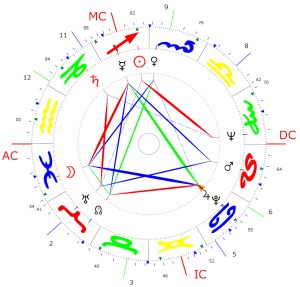
They took what they found to be the best of traditional astrology, and linked it with Assagioli’s psychosynthesis. Their method involves the innovative use of colour to highlight patterns and meaning in the birth chart, and the use of three separate charts to address different aspects of the person’s life.
The Huber Method is now a thriving tradition, which has been taught to tens of thousands of students, through API-related schools teaching in German, English and Spanish. Its aims include helping the personal growth of each student, producing counsellors who can be entrusted with helping the development of a human being using astrology as a tool, producing further teachers to spread the word, and
stimulating further research.
 The Astrological Psychology of Bruno & Louise Huber
Leave a comment