


By John D. Grove, MA, MSW
The last of three posts on John Grove’s researches at the Institute of Psychosynthesis, Florence, Italy.
Astrological-Psychological Research at the Psychosynthesis Institute in Florence and beyond
Bruno Huber and Roberto Assagioli worked together while Bruno and Louise Huber were residents in Florence, Italy with their headquarters at the Institute of Psychosynthesis. Their collaboration is described in Piercing the Eggshell, in which the following meaning of the planets seemed to appeal first to Dr. Assagioli:
“From a psychological point of view Dr. Assagioli felt that all people had the same basic abilities based on their common humanity. But everyone was given a slightly different combination of possibilities, and in different proportions which explained our individuality. He (Roberto) saw our basic potential in the planets and thought that here the relevant definitions could be very useful. But what was lacking in his opinion were reliable and unambiguous rules for interpretation.“
Apparently, it was while at the Institute that Bruno Huber constructed the initial figure for the Threefold Personality, copied by me in the previous post. This was probably the basis for the later “Planetary Table” in the book on the Planets.
Later Bruno constructed the House system with the House intensity curve which addressed relative strength of the planets based on their placement in the houses which answered Assagioli’s concerns. The Koch House system was chosen, as a result of the research.
The Age Point concept came after 1961 when “fate” wanted to demonstrate to Bruno that a specific point, the Age Point, could designate psychological crises as the Age Point traversed the Houses during a 72-year cycle which Huber later called the Life Clock. At different junctures, the Age Point would enter the cusp of a House and a crisis would ensue related to the definition of the House. For example, at age 30, the Age Point would enter the 6th house, the domain of work and one could face problems developmentally with survival in the real world of work.
This Age Point would travel to other Houses; at age 47 the low point of the 8th House could indicate a midlife crisis relating to one’s existential issues. The Age point would take six years to travel through one house starting at birth leading up to the 72nd year in which the cycle started again as it crossed the ascendant point and then a kind of psychological rebirth could potentially occur.
While at the Institute in Florence, Bruno Huber was introduced to artists and his own conceptualization of the horoscope using color was invented. He thought that Goethe’s Theory of Colors, (1810), Kandinsky’s Concerning the Spiritual in Art (1910) and the Max Luscher Color test (1969) revealed the psychological meaning of color as determined by the aspect angles in the horoscope.
In Florence Bruno Huber “started painting an abstract once every full Moon and once every new Moon …as an engagement with a visual medium reflecting inner motivation.”. The larger aspect patterns of Linear, Triangular or Quadrangular revealed unconscious motivations which formed a mandala with meaning that went beyond words.
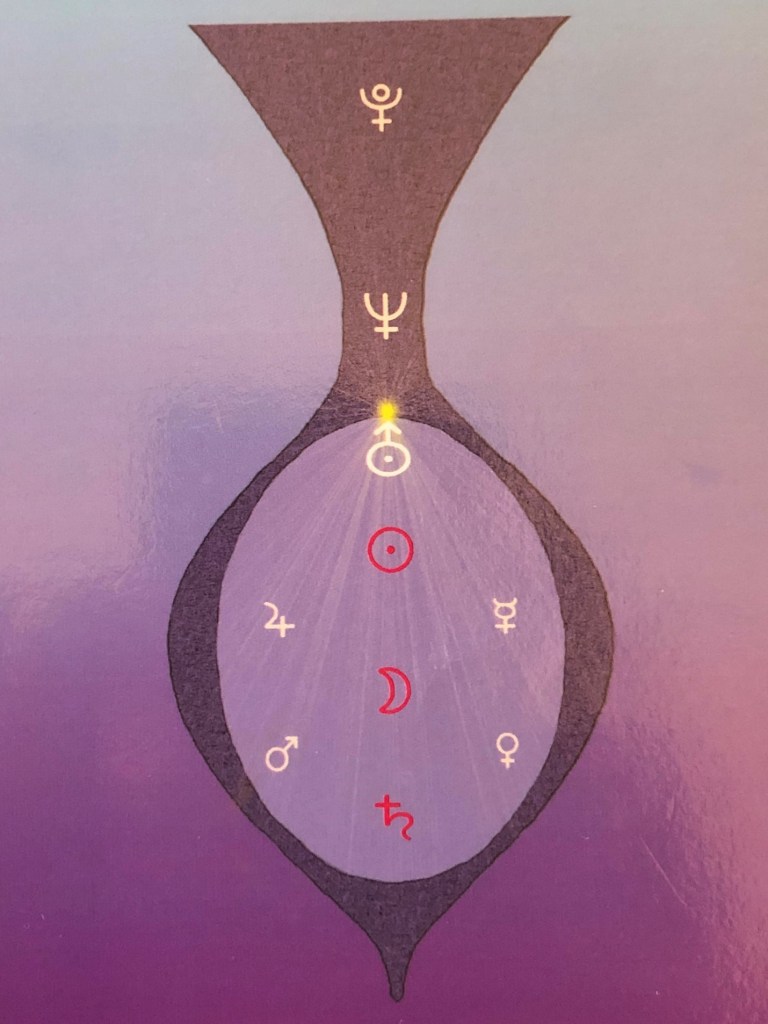
Bruno Huber’s later development of the figure is called an Amphora that was conceptualized at the Psychosynthesis institute in Florence. (Huber, Bruno, 1981, p. 132). Now it is depicted here alongside Roberto Assagioli’s egg. One can see the similarities between the figures with emphasis on “height psychology” which counterbalances depth psychology.
The practitioner first develops disidentification of the lower ego planets (in red) and then identifies with the concepts of the transpersonal planets (in white). The planet glyphs are seen along the vertical axis. The spiritual ascent to the transpersonal is a fundamental aspect of Astrological psychology. (Hopewell, Barry and Joyce ed., 2020)
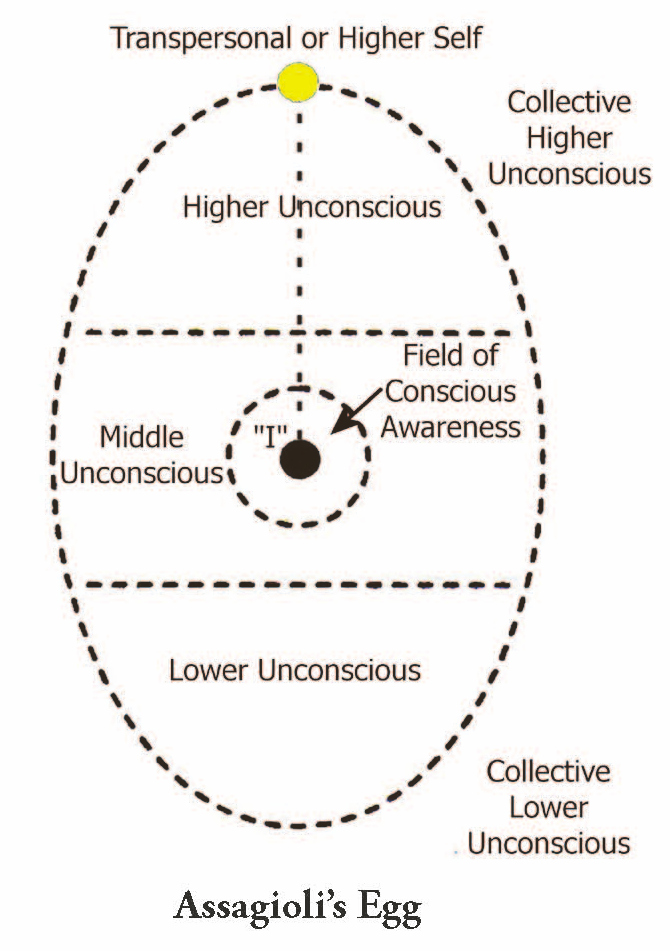
It is obvious that the influence of Roberto Assagioli on Bruno Huber’s development of his model for Astrological Psychology is profound and undeniable. We owe a debt of gratitude to the legacy and the thinking processes of Dr. Roberto Assagioli from his theory of Psychosynthesis.
Featured image of Florence by Amada44,
CC BY 3.0 https://creativecommons.org/licenses/by/3.0,
via Wikimedia Commons
References:
Assagioli, Roberto, Creating Harmony in Life: A Psychosynthesis Approach, Instituto Di Psicosintesi, Firenze, 1993, p.34
Archivio on Assagioli’s Astrological Studies, Instituto Di Psicosintesi, Firenze, 2025
Huber, Bruno and Louise. The Planets and their psychological meaning. Hopewell, Knutsford, England, 2006. p. 15
Hopewell, Barry and Joyce ed. Piercing the Eggshell. Hopewell Knutsford, England 2020. (pp. 41, 46, 49, 50, 52,63)
Archivio on Astrological Discussions,
Huber, Bruno and Louise, The Planets, Hopewell, Knutsford, England, 2006,p14
Huber, Bruno and Louise, Life Clock the Huber method of timing in the horoscope, Hopewell, Knutsford, England. 1983.
Lewis, Sue; in Hopewell, Barry and Joyce ed. Piercing the Eggshell. Hopewell. Knutsford, England, 2020. (pp. 53,54)
Huber, Bruno, Louise and Michael. Aspect Pattern Astrology, Hopewell, Knutsford, England, 2019.
Huber, Bruno, Astrological Psychosynthesis, Hopewell, Knutsford, England, 1981,2006.
 The Astrological Psychology of Bruno & Louise Huber
Leave a comment