
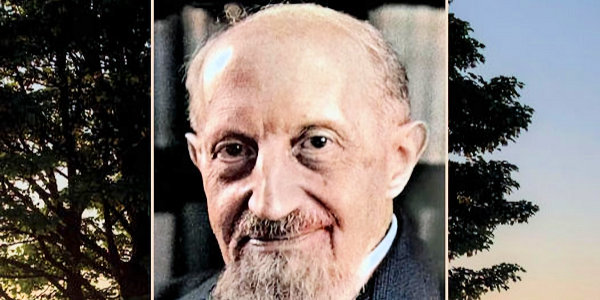
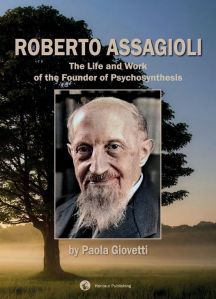
The story of the Hubers and their development of astrological psychology always refers back to the time they spent 1959-1961 with Roberto Assagioli at his Psychosynthesis Institute in Florence1. I have often wondered about Assagioli and his role in inspiring the Hubers to develop and teach astrological psychology, so was delighted to recently discover this biography Roberto Assagioli: The Life and Work of the Founder of Psychosynthesis, originally written in Italian by Paola Giovetti, published in English in 2024.
This was clearly a difficult biography to write, as details of some periods of Roberto’s life were somewhat sparse. As Giovetti says:
“Roberto Assagioli did not give much importance to his personal affairs, and Assagioli the man is found above all in his writings: what he cared about above all was to leave an idea, a model of life, naturally in line with his psychosynthetic conception.”
Early years
Roberto was born in 1888. At age 11 he had a visionary experience and “received the intuition about the structure of the psyche and the mystery of the Self”. By 1909 at age 21, the psychosynthesis concept was clear to him, based on Plato’s original idea of psychagogy – education of the psyche, or lifelong learning towards spiritual realisation. This was consistent with his deep involvement in theosophy and the concept of personal evolution.
Freud, Jung, Maslow
By 1909 he established good relationships with both Freud (then 53) and Jung (then 34). Jung and Assagioli respected Freud’s pioneering development of psychoanalysis, but each in their own way became aware of its limitations and moved on to their own work. It was actually Jung who proposed the term psychosynthesis that builds the future, in contrast to psychoanalysis that evaluates the past.
Assagioli regarded Jung as the closest to his own ideas. Individuation is not so different from psychosynthesis, except that Assagioli gave more emphasis to factors such as use of Will and the technique of disidentification; he regarded psychosynthesis as the psychology of the future, ‘the art of educating oneself’.
Assagioli was also a pioneer and major influence on the development of transpersonal psychology by Abraham Maslow and others.
The world wars
Both world wars on the European continent provided major interruptions to Assagioli’s career. During the inter-war years he developed psychosynthesis and its Institute, and the famous Egg diagram of the psyche. He was also active in theosophy, the Arcane School, the arts…
Italy was not fertile ground for Roberto; there was no interest in even the new psychoanalysis, let alone Roberto’s more advanced ideas. The death of this widely respected figure in 1974 was largely ignored in his home country. It is remarkable that the Psychosynthesis Institute was successfully established.
Roberto aimed to be the realisation of his own theories, exemplified by his time in prison during WW2, which he treated as a positive learning experience, and later wrote about.
Family and Astrology
The book tells the story of Roberto’s son Ilario, by his wife Nella, and his early death from TB. There is no mention of Bruno Huber, who was probably also Roberto’s son, out of wedlock2.
Assagioli was said to cast horoscopes very well, and was greatly interested in esoteric astrology. He said that these disciplines “would be integrated into psychology, to enrich and complete it.” What more natural, then that he would invite the budding polymath Bruno Huber to Florence to explore their common interest in psychological development and astrology3. It was this fertile collaboration that led to the development of Bruno’s astrological psychology.
Smiling wisdom
Assagioli was regarded by many as the best expression of his psychosynthesis. A great admirer of St Francis, he was a great practitioner of ‘smiling wisdom’, recommending cultivating humour in all situations. The ultimate goal of psychosynthesis was ‘creating a better world’.
This was the world view inherited by Bruno and Louise Huber, who I remember as joyful exponents of their astrological psychology.
In dark times, such as those of the world wars in Europe, the need for these ideas was crystal clear and proved an impetus to moving towards the ‘New Age’ light of the human spirit, away from the darkness of the times. A similar situation applies today, when we see authoritarian forces increasingly trying to dominate peoples and destroy the democracy that naturally aligns with personal growth and evolution.
We are each asked, where do we stand, and where are we going and growing?
This biography of Roberto Assagioli is well worth reading!
- See e.g. the Huber biography Piercing the Eggshell: The Hubers and their Astrological Psychology. ↩︎
- ibid. ↩︎
- ibid. ↩︎
 The Astrological Psychology of Bruno & Louise Huber
Leave a comment