

This article was first published by Bruno Huber in the magazine Astrolog in 19951, under the title “Lean Years: When Saturn Loses its Rings”, subsequently published in English in the book Astrolog I2.
As we find ourselves today in one of Saturn’s ‘lean’ periods3, it appears to offer some insight into the current world situation of changing systems and existential insecurity.
When Saturn loses its Rings

Saturn, the upholder and securer of our existence, undergoes significant oscillations in brightness and hence visibility from earth. It is currently (August 1995) in its dimmest phase, which always happens when, as now, it transits the sign of Pisces, or that of Virgo.
Previous generations of astrologers, back into antiquity, spoke of “seven fat years and seven lean years”, and numerous legends were woven around this phenomenon. The word “lean” indicates that these were understood as seven years of lean living, i.e. poor harvests, poor business, possibly crisis. Although we live in a prosperous society (compared with past centuries), mass psychological symptoms of the fear of the lean years can still be observed today. At these times, most people have a degree of existential angst, whether there are rational reasons for it or not. They think they have to cut back spending on non-essential items and invest their money in material assets.
In this case, there is actually an astronomical law behind the phenomenon. The fat years are the seven bright years of Saturn, which are always followed by seven dim (lean) years. But why does Saturn, to which we attribute steadiness and regularity, show this “temperamental” oscillation?
The famous Dutch astronomer and telescope maker Huygens found the solution in 1655. The phenomenon of varying brightness is related to Saturn’s rings, whose existence was unknown before Huygens. He discovered that Saturn (in his words translated): “is surrounded by a ring that is flat and unsupported and inclined towards the ecliptic.”

as it disappears and reappears in the hand drawing of Huyghens
top: March 1655, centre: January 1656, bottom: October 1656
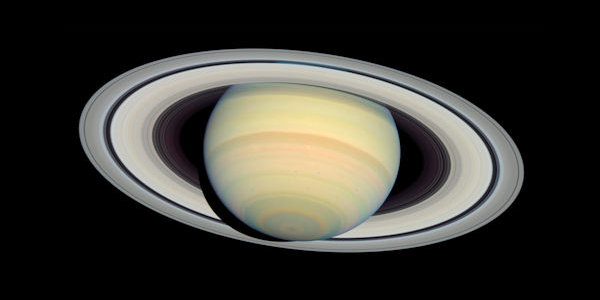
Nowadays, we are all familiar with the beautiful photos of Saturn provided by space probes: a ball surrounded by a flat ring. Most of these images show it from the same angle – from diagonally above.
This image is not always available to us on Earth though, for in its orbit of the Sun, lasting nearly 30 years (29.457 years), it shows us all its sides. Saturn’s axis, around which the planet rotates in 10 hours and 14 minutes, is like the Earth’s axis inclined towards the ecliptic (Sun’s orbit), which also leads to the existence of seasons. And not only this: its rings are at a right angle to its axis and therefore also form an angle with the ecliptic, i.e. they are highly tilted in our line of sight.

Reflections
During its orbit of the Sun, Saturn’s axis remains firmly aligned to the signs of Gemini and Sagittarius. Saturn’s Equinoxes and Solstices (cardinal points) therefore do not lie in the cardinal cross but in the mutable cross.
If now in its passage it arrives in Sagittarius, we see its rings in the greatest possible inclination from above. And when about 15 years later it has reached Gemini, we get an optimal view of them from below. The effect of this is that the planet and rings together reflect the sunlight. That is the full (or even “fat”) light of Saturn. When it is half-way between these two signs, in Virgo or Pisces, we see the rings edgeways on. Seen from the earth, they are then no more than extremely thin lines that can only be seen with a powerful telescope. They are no longer visible with the naked eye. Now the rings do not reflect sunlight to us, only the planet itself acting as a reflector. From our point of view, Saturn has temporarily lost its rings, which results in a much dimmer light. Sometimes we can only see it in the second half of the night. At these times, we must know which of the visible stars is Saturn, for it does not stand out particularly from the surrounding fixed stars. At the other extreme, in its “fattest” times, Saturn can put even the brightest fixed stars in the shade. This happened seven years ago (about 1988) in Sagittarius, and will happen again in another seven years when it passes through Gemini.
Strangely enough, the quarter in which Saturn is at its brightest also contains the highest number and brightest fixed stars (the quarters where the Milky Way crosses the ecliptic in the constellations Taurus/Gemini and Scorpio/Sagittarius). In the lean years, however, it traverses a to-the-naked-eye poorly populated and dim quarter of the zodiac (the constellations Virgo, Libra, Aquarius and Pisces).

Existential Angst
The Virgo-Pisces axis is known as the existence axis of the zodiac. When Saturn passes through one of these signs and is also at its dimmest, then more or less obvious symptoms of existential angst can be observed in the human collective. That can be expressed in very different ways by different ethnic groups and by different people. The scale of angst ranges from the feeling of being threatened by fate, by society or by individuals, through to simple pessimism or general defeatism to aggression or even, as projection or defence mechanism, to the willingness to go to war (crusade reaction).
Strangely enough, on closer inspection, these forms of angst often cannot be clearly traced back to truly threatening concomitant circumstances. It appears to be more a kind of mass psychosis, of which most people are largely unaware. The reaction is also usually different during the transits of Pisces and Virgo. In Pisces, one feels oneself to be the victim of unfortunate/evil circumstances. The feeling of helplessness overcomes one and resignation can also be observed. In Virgo, the moans can also be heard, but there is much more a tendency to take action against the threat. Many proposed solutions and one-size-fits-all philosophies are put forward, from which however in retrospect some turn out to be unrealistic “tilting at windmills”.
Corresponding ways of reacting as personal character traits can also be observed in people born during these periods, thus having Saturn in Pisces or Virgo in their horoscope. Naturally, the character traits are modified in their personal characteristics by their different house positions (environmental influences). Furthermore, the different aspecting of these Saturn positions indicate a correspondingly different personal interpretation and transfer of such Saturn qualities that is unique to the individual.
“Ringlessness”
The above-mentioned properties are most visible, both in contemporary collective events and in the character of the Saturn in Pisces/ Saturn in Virgo people, when Saturn is “ringless”, i.e. in the shorter or longer period during which its rings are not visible. The length of this phase differs depending on whether they are near the opposition or conjunction with the Sun. In the vicinity of the conjunction, the “ringless” phase lasts about three or four months, while near the opposition it lasts between nine and thirteen months. Out of the seven “ringless” phases in this century, only one (1950) was a shorter one (see table). The current one will last from March 1995 until March 1996, i.e. around 12 months. The absolute zero point (when it is invisible even with a ten-inch telescope) is repeated three times: on 22.5.95, 10.8.95 and 12.2.96. Already in May 96, the attentive observer may notice a marked increase in Saturn’s brightness when Saturn would not already have passed over in the sky during the daytime.
‘Ringless’ phases from 1900
| 9-13 months | 3-4 months |
| 1907/8 | 1950 |
| 1920/21 | 2009 |
| 1936/37 | 2025 |
| 1966/67 | |
| 1979/80 | |
| 1995/96 | |
| 2038/39 |
As a rule of thumb, in order to establish the phase of “ringlessness” in a personal horoscope, one can assume: if Saturn is either in Pisces or Virgo and simultaneously in conjunction or opposition to the Sun.
One can assume that the period of poorest luminosity lasts about 2 years, which corresponds almost exactly to the transit through Pisces or Virgo. The lean years in total though last between 6 and 8 years.
Occurrences of the “edge-on position of Saturn” – as astronomers call it – are about 13.75 years apart when it is moving from Pisces via Gemini to Virgo, or 15.75 years on its journey from Virgo via Sagittarius to Pisces. In the middle of these phases lie the roughly seven “fat years”. The next occurrence will be from 1998 – 2005.
To sum up, we can say that:
When Saturn “loses” its rings, it reacts with irritation and anxiety, for the rings represent its ability to keep danger at bay (protective ring) and therefore in mankind there arises a loss of confidence in its ability to protect itself (existential insecurity), which just eats away at self-confidence.
Featured image of Saturn is from NASA website,
by Hubble telescope 2004.
Footnotes
- First published in German in ‘Astrolog’ Issue 87, August 1995. ↩︎
- The article is included in English in the book Astrolog I: Life and Meaning. ↩︎
- The current lean period of Saturn began in March 2025, when Saturn was still in Pisces (now moved to Aries). ↩︎
 The Astrological Psychology of Bruno & Louise Huber
Leave a comment