
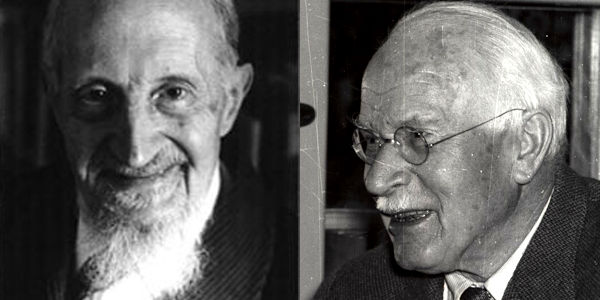
Huber astrology is based on Roberto Assagioli’s psychosynthesis, and originated during the period of collaboration between Bruno & Louise Huber and Assagioli1. The Hubers would have also been aware of the work of Carl Jung and his analytical psychology, based in their home city of Zurich, so why did they follow the Assagioli route? Probably because they were involved in the same spiritual tradition through the Arcane School2. A glance at the two psychological ‘systems’ may help to clarify why psychosynthesis was more appropriate for them.
Assagioli’s Psychosynthesis vs Jung’s Analytical Psychology
I am indebted to Chatgpt for the following comparison3.
1. Spiritual Emphasis
Assagioli puts a stronger emphasis on the spiritual or transpersonal dimension. Psychosynthesis sees spiritual development and the realization of the Higher Self as central to psychological growth.
Jung also explored spirituality (especially later in life), but his approach was more rooted in myth, archetypes, and the collective unconscious. Jung was cautious about “mysticism,” although he studied alchemy, symbols, and Eastern philosophy.
Assagioli directly integrates spiritual practices like meditation and visualization into therapy — Jung was more symbolic and interpretive about such experiences.
2. Structure of the Psyche
Assagioli offers a clear model of the psyche — including the lower unconscious (repressed material), middle unconscious (memories/habits), higher unconscious (intuition, inspiration), and the Self.
Jung described the psyche in more mythopoetic and symbolic terms — ego, personal unconscious, collective unconscious, and archetypes. He emphasized inner exploration through dream analysis, active imagination, and individuation.
Assagioli’s model is more structured and accessible, while Jung’s is more abstract and metaphorical.
3. Subpersonalities vs. Archetypes
Assagioli introduced the concept of subpersonalities — different roles or parts within us (e.g., inner child, perfectionist, rebel) that need integration and alignment with the Self.
Jung focused on archetypes, which are universal patterns or symbols (e.g., the Shadow, the Anima/Animus, the Wise Old Man) shared across humanity via the collective unconscious.
Subpersonalities are more individual and practical, while archetypes are more symbolic and universal.
4. Therapeutic Goal
For Assagioli the goal is synthesis — to harmonize and integrate all parts of the self in service of the Higher Self and a sense of life purpose.
For Jung the goal is individuation — becoming one’s true, whole self by integrating unconscious content and accepting inner opposites (e.g., shadow, anima/animus).
Both aim for wholeness, but Assagioli’s path is more constructive and future-oriented, while Jung’s is more explorative and depth-focused.
Shared Ground
Both saw the psyche as more than just a battleground of impulses (unlike Freud). Both valued dreams, symbols, the unconscious, and personal growth. Each broke with Freud over his reduction of everything to sexuality or childhood trauma.
If Jung is like the mythologist-mystic, Assagioli is the map-maker-mediator — bringing psychology, spirituality, and practical integration together in a more user-friendly, optimistic package.
Did Assagioli and Jung ever interact or work together?
According to Chatgpt, Roberto Assagioli and Carl Jung did interact, though they never formally worked together in a deep or sustained collaboration. Their paths crossed intellectually and personally, especially in the early 20th century, but they each developed their own distinct schools of thought.
Assagioli was active in early psychoanalytic circles in Europe — he was the first psychoanalyst in Italy and initially trained in Freud’s tradition. Around 1910–1913 he became interested in Jung’s early work, especially Jung’s break from Freud and his interest in the symbolic and spiritual dimensions of the psyche.
Assagioli and Jung met a number of times in the 1930s. Assagioli respected Jung but also made it clear that he had distinct differences, especially in his emphasis on the Higher Self and a more explicitly spiritual orientation.
Jung was more focused on archetypes and individuation through exploration of the unconscious. Assagioli admired Jung’s openness to myth and spirituality, but he wanted a more integrative and directive path toward wholeness, including tools like meditation, guided imagery, and will development.
“Among psychotherapists, Jung is one of the closest and most akin to the conceptions and practice of psychosynthesis.”
Psychosynthesis Trust
Further reading
The interested reader may wish to follow up in more detail, for example by looking up articles on the website of the Psychosynthesis Trust, including that by Assagioli on Jung and Psychosynthesis.4.
Featured image shows Assagioli and Jung in their later years, via Wikimedia Commons.
Footnotes
- See eg Piercing the Eggshell: The Astrological Psychology of Bruno & Louise Huber, chapter 5. ↩︎
- ibid, chapter 4. ↩︎
- Edited results of a conversation with Chatgpt April 16th 2025. ↩︎
- See Psychosynthesis Trust Website. ↩︎
 The Astrological Psychology of Bruno & Louise Huber
Leave a comment